Quality of Life

Share your experience – it takes about 10 minutes

For patients, survivors, carers and family members. Health professionals close to care are also welcome.

Confidential – You can stop at any time – If you wish, we will invite you to a workshop or interview

Why this topic matters

Symptoms

Symptoms such as fatigue, pain and nausea can affect how yo feel and what you can do.

Emotional wellbeing

Living with uncertainty and worry can impact mood and mental health.

Daily life & relationships

Liver cancer can influence routines, roles and the connections that matter.

What we want to learn

Symptoms

Which symptoms matter most and how they affect everyday life.

Energy & functioning

How fatigue and physical limitations affect activity and independence.

Emotional impact

The emotional challenges and how people cope and stay resilient.

Social support

The role of family, friends and community in patient wellbeing.

Priorities for care

What matters most to you and what could improve your care.

Which are the main possible symtoms?

1. Appetite & weight changes

Loss of appetite, feeling full quickly, weight loss.

2. Extremity symptoms

Numbness, tingling or swelling in hands, arms or legs.

3. Fatigue & loss of strength

Feeling very tired or weak, loss of muscle strength.

4. Digestive symptoms

Nausea, vomiting, diarrhea, constipation, bloating.

5. Pain

Pain in the abdomen, shoulder or other areas.

6. Sensory changes

Changes in taste or sense of smell.

7. Skin changes

Itchy skin, yellowing of skin or eyes, changes in skin color.

8. Other symptoms

Dizziness, shortness of breath, dry mouth, trouble sleeping, and more.

How it can affect daily life

1. Emotional well-being

Feelings, stress, body image, worry.

2. Cognitive function

Memory, focus, mental clarity.

3. Physical functioning

Energy, movement, activities and self-care

4. Other daily-life impacts

Relationships, routines, finances, social life.

Source: Patel, N., et al. 2022. Understanding the patient experience in hepatocellular carcinoma: A qualitative patient interview study. Quality of Life Research, 31(2), 473–485. https://doi.org/10.1007/s11136-021-02903-4

What the literature highlights

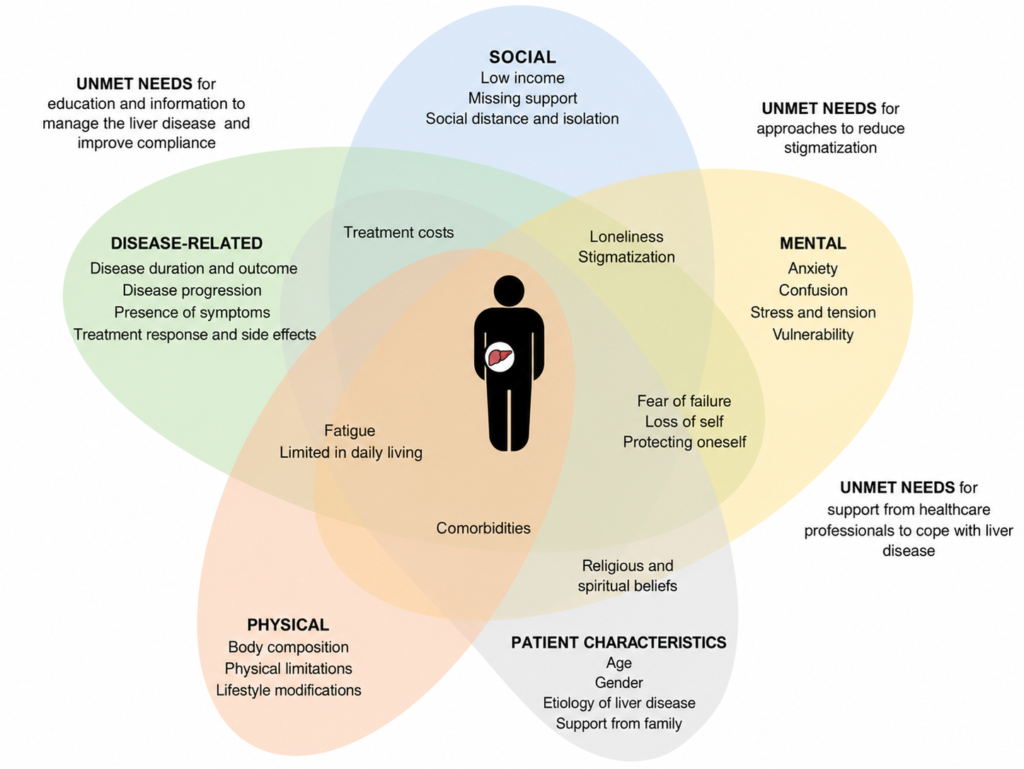
Quality of life is shaped by physical, emotional, social and practical factors.

Symptoms burden can affect daily activities and independence.

Understanding patient priorities helps improve supportive care.

Source: Grønkjær, L. L., & Lauridsen, M. M. (2021). Quality of life and unmet needs in patients with chronic liver disease: A mixed-method systematic review. JHEP Reports, 3(6), 100370. https://doi.org/10.1016/j.jhepr.2021.100370


Selected reading

Norman, et al., 2022

Hepatocellular carcinoma and its impact on quality of life: A review of the qualitative literature. European Journal of Cancer Care, 31(6):e13672

Serper, et al., 2022

Patient-reported outcomes in HCC: A scoping review by the Practice Metrics Committee of the American Association for the Study of Liver Diseases. Hepatology. 76(1):251-274

Kang, et al., 2020

Systematic Review of Studies Assessing the Health-Related Quality of Life of Hepatocellular Carcinoma Patients from 2009 to 2018. Korean Journal of Radiology, 21(6):633-646

How you can contribute

1. Interviews

One-to-one conversations to understand personal
experiences and priorities.

2. Group conversations

Small group discussions to
share experiences and identify common themes.

3. Co-creation activities

Collaborative activities to generate ideas and explore solutions together.

4. Prioritisation of needs

Helping to prioritise what
matters most to improve
living with liver cancer.

Patients & survivors

Share your experiences and help shape research that reflets what matters to you.

Carers & family members

Your perspective helps us understand the impact on loved ones.

Healthcare professionals

Contribute your insights to improve patient-centred care and support.

All activities follow ethical principles of respect, confidentiality and voluntary participation.

In collaboration with

Your experience can help improve liver cancer care.

Together we can put what matters most to patients at the heart of research and care.

Living Labs

People involved

Skip to content