Adoption of Innovation

Contribute your expertise – it takes about 10 minutes

For healthcare professionals, managers, procurement teams and health technology researchers.

Confidential – No identifiable clinical data is collected – If you wish, we will invite you to a professional workshop

Why this topic matters

Clinical value & safety

New technologies must deliver meaningful benefits without compromising patient safety.

Usability & workflow

Technology needs to fit clinical
routines, teams and real working environments.

Adoption & sustainability

Evidence, resources, leadership and
context determine whether innovation
lasts.

What we want to learn

1. Clinical need & value

Priority indications, expected benefits, limits of use, patient value and the evidence needed to support decisions.

2. Usability, workflow & safety

Set-up, ergonomics, surgical workflow, technical and human risks, compatibility and safe everyday use.

3. People, training & acceptability

Roles, skils, learning curves, training, professional confidence, patient information and acceptability.

4. Implementation, scale-up & sustainability

Organisational readiness, procurement and HTA, funding, monitoring, adaptation and conditions for wider adoption.

What the literature highlights

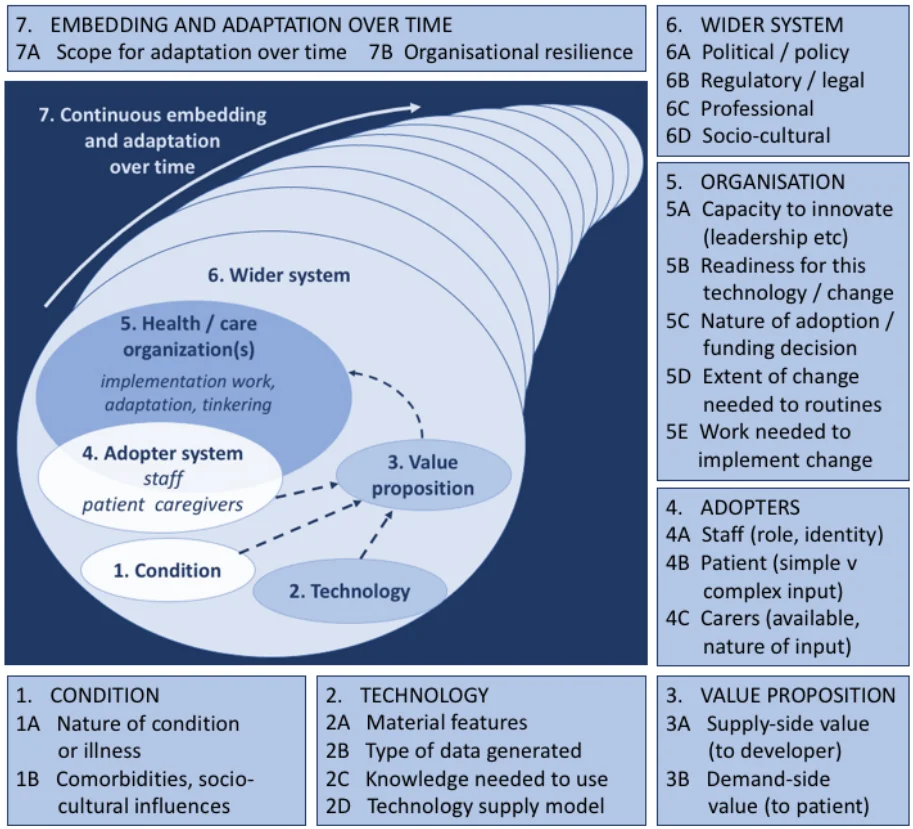
Successful adoption depends on interacting clinical, technological, professional, organisational and contextual factors.

Organisations and adopter systems are frequently reported sources of implementation barriers.

Evidence, regulation, HTA, reimbursement and professional adoption can shape medical-device diffusion.

Published NASSS framework

Source: Greenhalgh, T., Wherton, J., Papoutsi, C., et al. (2017). Beyond Adoption: A New Framework for Theorizing and Evaluating Nonadoption, Abandonment, and Challenges to the Scale-Up, Spread, and Sustainability of Health and Care Technologies. Journal of Medical Internet Research, 19(11), e367. https://doi.org/10.2196/jmir.8775

Selected reading

Greenhalgh, et al., 2017

Beyond Adoption: A New Framework for Theorizing and Evaluating Nonadoption, Abandonment, and Challenges to the Scale-Up, Spread, and Sustainability of Health and Care Technologies. Journal Medical Internet Research, 19(11):e367.

Shin, et al., 2025

The NASSS (Non-Adoption, Abandonment, Scale-Up, Spread and Sustainability) framework use over time: A scoping review. PLOS Digital Health, 4(3): e0000418

Warty, et al., 2021

Barriers to the Diffusion of Medical Technologies Within Healthcare: A Systematic Review,” in IEEE Access, 9, 139043-139058.

How you can contribute

1. Interviews

One-to-one conversations to understand experiences, expectations and barriers.

2. Group conversations

Small group discussions to
identify shared needs and implementation challenges.

3. Co-creation activities

Collaborative activities to improve usability, safety and implementation plans.

4. Prioritisation of needs

Helping identify the changes and conditions that matter most for successful adoption.

Patients & representatives

Share what makes a technology understandable, acceptable and valuable for patients.

Healthcare professionals

Contribute experience of usability, workflow, safety, training and clinical value.

Managers & decision-makers

Contribute insights on implementation, HTA, procurement, resources and sustainability.

All activities follow ethical principles of respect, confidentiality and voluntary participation.

In collaboration with

Your experience can help make healthcare innovation work.

Together we can identify what technologies need to be useful, safe and sustainable in real care.

Living Labs

People involved

Skip to content