The adoption of new technologies in healthcare is a complex, multifactorial process that extends beyond technical performance alone. Clinical considerations, organizational structures and professional practices all play a critical role in determining whether an innovation will be successfully adopted.
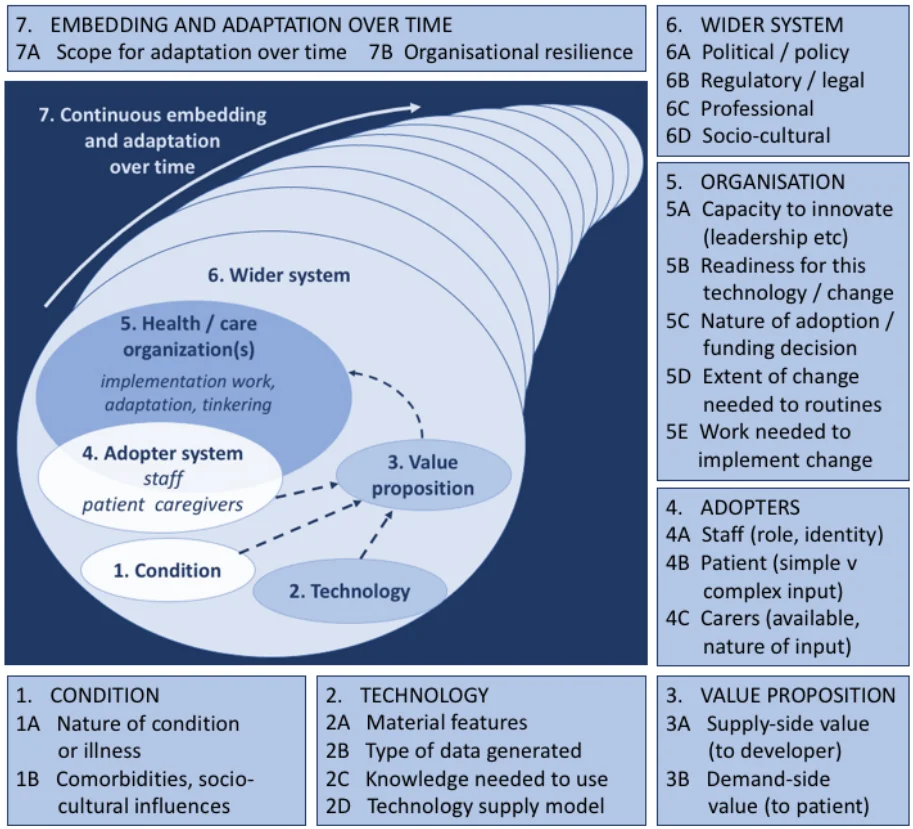
In this context, the NASS Framework (Non-Adoption, Abandonment, Scale-up, Spread and Sustainability) is particularly useful for analysing technological innovations from a comprehensive perspective. It considers seven interrelated domains – the condition (1), the technology itself (2), the value proposition (3), the adopters (4), the organization(s) (5), the wider system context (6) and the embedding and adaptation over time (7) – and assesses the level of complexity associated with each of them (1). The NASS framework has proven to be especially valuable for informing study design and for identifying barriers and facilitators especially within the Organization(s) (5), Adopter (4) and Value proposition (3) domains (2). Overall, beyond technical performance, a technological innovation must be able to integrate into clinical practice in a viable and sustainable way.
Our research will use the COOLINGBIS device as a case example to support an applied discussion on the factors that influence the adoption of technological innovations in healthcare. COOLINGBIS is a medical technology that uses radiofrequency to enhance ablation margins in liver surgery (3, 4). Given its clinical relevance and its potential application in a highly complex surgical setting, it represents a particularly suitable case for exploring how a technological innovation can be assessed, adopted, and integrated into real-world clinical practice.
If you would like to take part and share your experience, don’t hesitate to get in touch. Your insights can help shape better care for people living with liver cancer!
To contact us, you can use the messaging box below, indicating your name and email address so that we can get back in touch with you. Alternatively, you can write to us by email at the following email address: xxxx@fadq.org
You can consult our privacy policy at the following link.
As the study progresses and data is collected and analysed, we will update the content of this section and make the findings publicly available.
1. Greenhalgh, T., Abimbola, S. The NASSS Framework A Synthesis of Multiple theories of Technology Implementation. Studies in Health Technology and Informatics. (2019) 263:193-204. Doi: 10.3233/SHTI190123.
2. Shin, H. D., Hamovitch, E., Gatov, E., MacKinnon, M., Samawi, L., Boateng, R., Thorpe, K. E., & Barwick, M. The NASSS (Non-Adoption, Abandonment, Scale-Up, Spread and Sustainability) framework use over time: A scoping review. PLOS Digital Health. (2025) 4. Doi: 10.1371/journal.pdig.0000418.
3. Quesada, R., Poves, I., Berjano, E., Vilaplana, C., Andaluz, A., Moll, X., Dorcaratto, D., Grande, L., Burdio, F. Impact of monopolar radiofrequency coagulation on intraoperative blood loss during liver resection: a prospective randomised controlled trial. International Journal of Hyperthermia. (2017) 33(2): 135–141. Doi: 10.1080/02656736.2016.1231938.
4. Villamonte, M., Burdío, F., Pueyo, E., Andaluz, A., Moll, X., Berjano, E., Radosevic, A., Grande, L., Pera, M., Ielpo, B., Sánchez-Velázquez, P. The impact of additional margin coagulation with radiofrequency in liver resections with subcentimetric margin: can we improve the oncological results? A propensity score matching study. European Journal of Sugrical Oncology. (2021) 48:82-88. Doi: 10.1016/j.ejso.2021.06.008
5. Greenhalgh, T., Wherton, J., Papoutsi, C., Lynch, J., Hughes, G., A’Court, C., Hinder, S., Fahy, N., Procter, R., Shaw, S. Beyond Adoption: A New Framework for Theorizing and Evaluating Nonadoption, Abandonment, and Challenges to the Scale-Up, Spread, and Sustainability of Health and Care Technologies. J Med Internet Res. (2017) 19(11):e367. Doi: 10.2196/jmir.8775