CANCER CARE EXPERIENCE

WHAT SHAPED YOUR EXPERIENCE OF CARE?

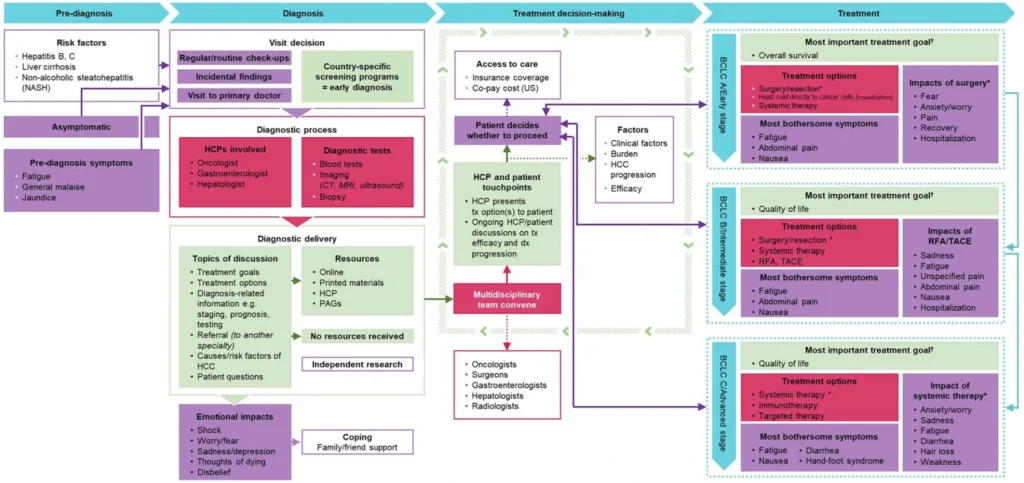
The Liver Cancer Care pathway is complex, multidisciplinary and extends over a prolonged period of time. Research shows that patient’s experiences depend not only on the treatments they receive, but also on how information is communicated, interpreted, and used to make decisions at critical points along the pathway (1, 2)

Over the course of the care pathway, care experience is shaped by multiple key moments, transitions and points of contact including diagnostic suspicion, referrals, information received, preparation for surgery or other treatments, the hospital stay, dischargement, recovery at home, clinical follow-up and access to support. Because these shape the care experience, they also allow us to assess how care was perceived

Existing literature indicates that patients with liver, biliary, or pancreatic tumours wish to understand the reasons behind clinical decisions and to be involved in their own care. However, the extend of this involvement depends on when information is provided, the language used, and whether patients are given real opportunities to ask questions or express their preferences (3). At the same time, studies in oncology have shown that patient-perceived coordination and support interventions can improve continuity of care, clarify roles and increase satisfaction, particularly in complex and multidisciplinary care pathways (4, 5). 

This is where our research comes in. We aim to further expand the available knowledge of the care experience of patients with liver cancer by identifying their unmet needs, prioritizing them, and beginning to articulate potential solutions to address them.

DO YOU WANT TO PARTICIPATE?

If you would like to take part and share your experience, don’t hesitate to get in touch. Your insights can help shape better care for people living with liver cancer!

To contact us, you can use the messaging box below, indicating your name and email address so that we can get back in touch with you. Alternatively, you can write to us by email at the following email address: xxxx@fadq.org

You can consult our privacy policy at the following link.

WHAT HAPPENED SO FAR?

As the study progresses and data is collected and analysed, we will update the content of this section and make the findings publicly available.

NEXT WORKSHOPS TAKING PLACE

SPAIN

Master of Multidisciplinary Research in Experimental Sciences

Duration

2h

Mode

Online

Language

English

Place

Barcelona

  • 00Days
  • 00Hours
  • 00Minutes
  • 00Seconds

BIBLIOGRAPHY AND EXISTING LITERATURE

1. Wörns, M.A., Burns, D., Paskow, M.J., et al. Patient Experience of Hepatocellular Carcinoma and their treatment Goals: An International Qualitative Study and Patient Journey Map. Adv Ther. (2024) 41(09): 3598-3614. Doi: 10.1007/s12325-024-02939-1
2. Choi, D.T., Using telemedicine to facilitate patient communication and treatment decision-making following multidisciplinary tumor board review for patients with hepatocellular carcinoma. Journal of Gastrointestinal Cancer. (2023) 54(2): 623-631. Doi: 10.1007/s12029-022-00844-w
3. Ibrahim, F., Sandström, P.A., Björnsson, B., et al. ‘I want to know why and need to be involved in my own care…’: a qualitative interview study with liver, bile duct or pancreatic cancer patients about their experiences with involvement in care. Support Care Cancer. (2019) 27:2561-2567. Doi: 10.1007/s00520-018-4548-8
4. Jackson, G.L., Zullig, L.L., Phelan, S.M., et al. Patient characteristics associated with the level of patient-reported care coordination among male patients with colorectal cancer in the Veterans Affairs health care system. Cancer. (2015) 121(13):2207-2213. Doi: 10.1002/cncr.29341.
5. Van Ryn, M., Sanders, S., Kahn, K., et al. Patient-reported quality of supportive care among patients with colorectal cancer. J Clin Oncol. (2014) 32(8):809-815. Doi: 10.1200/JCO.2013.49.4302

Living Labs

People involved

Skip to content